
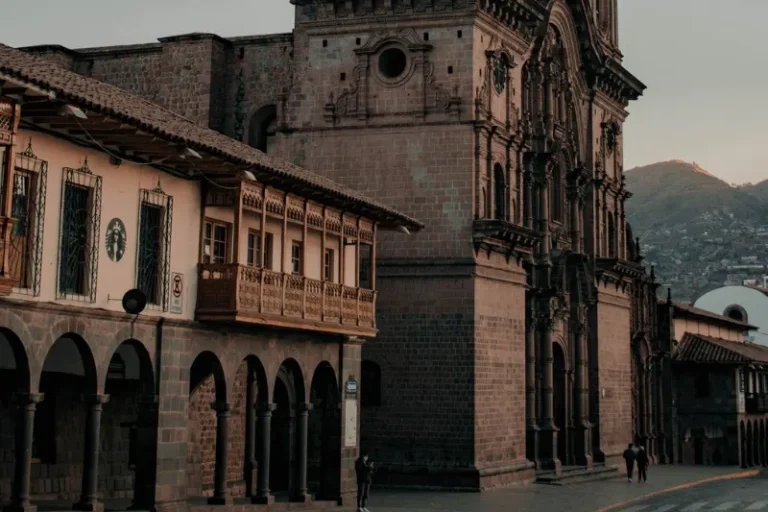
Stand in Cusco’s Plaza de Armas and two buildings immediately compete for attention. One is a cathedral assembled from the stones of a palace the Spanish demolished to build it. The other was designed by a religious order that wanted something grander than Rome. Neither one is subtle about what it’s trying to say, and that tension is pretty much the whole story of this city.
The churches and convents in Cusco aren’t museums in the traditional sense. They’re the physical record of a collision between two civilizations that neither side ever fully resolved. Every carved doorway, every canvas, every foundation stone is evidence of something that happened here and never quite finished happening.
Three religious orders, the Dominicans, the Jesuits, and the Franciscans, spent decades competing for spiritual control of the same city. The indigenous artisans they hired to decorate their spaces had different ideas about what that decoration should actually say.

How the Cusco Cathedral Recycled an Inca Palace
Building the cathedral took over a century, which makes sense once the construction method becomes clear. Spanish authorities put indigenous laborers to work hauling granite blocks from the ruins of Viracocha’s palace nearby. That practical decision accidentally embedded Inca heritage directly into the walls of the most important Catholic building in the city, which is either ironic or perfect depending on how you look at it.
Inside, the Cusco School paintings cover everything. Three details in particular tend to stop visitors mid-step:
- A Last Supper where the main dish is roasted guinea pig rather than bread.
- Cedar choir stalls with indigenous faces worked into the Catholic designs.
- A silver altar weighing hundreds of pounds that reflects exactly how much mineral wealth the Andes produced for Spain.
None of those details is the most important thing in the building though. That distinction belongs to Taytacha Temblores, a dark-skinned Christ figure local tradition credits with stopping a devastating 1650 earthquake. Cusco adopted him as its patron saint and never let go. That kind of devotion made the cathedral politically untouchable, even when the Jesuits arrived next door with considerably larger ambitions.
The Golden Rivalry of La Compañía de Jesús
The Jesuit church on the plaza wasn’t designed to fit in. It was designed to win. The order wanted something that would visually overshadow the cathedral standing right beside it, and the resulting ambition generated enough political friction that a petition to the Pope himself was reportedly filed to stop construction before it went too far.
What got built is what happens when Spanish baroque runs through indigenous Andean hands. European columns wrapped in carved tropical flowers and papaya vines, traditional swirling patterns cut into pink volcanic rock by artisans who understood exactly what they were embedding in the stone. The exterior belongs to neither culture entirely and both of them simultaneously.
The interior goes further. Gold leaf altars rising floor to ceiling, an overwhelming sensory environment built to cement Jesuit dominance over a city they arrived in late. It worked then as spectacle and it works now. A few blocks away though, the Dominican Order had already made a more permanent statement by building directly on top of the empire’s most sacred ground.

Where the Sun God Met the Dominican Order: The Coricancha/Santo Domingo Collision
The Santo Domingo Convent sits on top of the Coricancha, the Golden Enclosure, the most important temple in the entire Inca Empire. The symbolism was deliberate. One civilization’s holiest site became another civilization’s literal foundation, and the building that resulted from that decision has been making the same argument for five centuries.
What the Spanish didn’t fully calculate was how well the bottom would hold up. Inca ashlar masonry, stones fitted so precisely they require no mortar, has survived every significant earthquake Cusco has experienced. The colonial additions above those walls have crumbled and been rebuilt multiple times. The Inca stonework at the base hasn’t needed any of that attention.
The dark smooth walls visible at ground level today are the same walls that were there when the Spanish arrived. Everything built on top has been repaired, replaced, or modified. The foundation hasn’t. That’s a five-hundred-year geological argument that keeps getting made every time another tremor hits the city.
Decoding the Secret Symbols of the Cusco School of Art
Walk into any colonial church here and a hidden conversation is happening on the walls. Spanish priests commissioned European-style paintings to teach Catholic doctrine. The indigenous artists who painted them heard the brief and then quietly did something else. What resulted is one of the more remarkable acts of cultural survival in the colonial Americas.
Four symbols appear across these works once someone knows to look:
- Triangular Dresses: The Virgin Mary painted with an unnaturally wide rigid skirt shaped like an Apu, a sacred Andean mountain, quietly transforming her into Pachamama.
- Andean Flora: Biblical backgrounds replaced with local jungle flowers and macaws that had no business appearing in Jerusalem.
- The Guinea Pig: The cathedral’s Last Supper has the disciples eating roasted cuy instead of a Passover meal.
- Harquebusier Angels: Heavenly figures carrying Spanish muskets while dressed in the feathered garments of Inca nobility.
Knowing these details changes how the entire city reads. A wide skirt becomes a statement. A guinea pig on a biblical table becomes an argument. This visual code didn’t stay on canvas either. It moved into wood, and nowhere more dramatically than in a modest church on a cobblestone hill in San Blas.

Why the San Blas Pulpit is a Masterpiece of Wood and Mystery
The San Blas neighborhood sits above the plaza in narrow streets that feel genuinely old in a way the tourist center sometimes doesn’t. The church there looks ordinary from outside, which is part of why the pulpit inside hits the way it does. Carved from a single tree trunk, considered the finest colonial cedar woodwork in the Americas, and the claim doesn’t feel exaggerated standing next to it.
No gold leaf anywhere on this one. The wood handles everything, carved into saints and angels and botanical vines that blend Andean and European imagery without announcing which is which. The technical skill involved is remarkable on its own. The story attached to it makes it something else.
The legend holds that the indigenous master carver knew he was dying and asked to be entombed inside his creation when he finished. Near the top of the canopy a human skull sits embedded in the carving. Whether the story is literally true or not, someone put that skull there, and the effect it produces is exactly what it was designed to produce.
Descending into the Hidden Catacombs of San Francisco
The Franciscans went in a completely different direction from the Jesuits. Vows of simplicity over gold leaf, austere stone over theatrical scale. The San Francisco Convent reflects those commitments on the surface. What’s underneath it is harder to categorize.
Descending into the catacombs means walking through passageways lined with the neatly arranged bones of thousands of early colonial residents. The social hierarchies that defined life in the city above don’t survive the descent. Wealth, rank, religious standing, none of it makes any difference down there, which may or may not have been the point.
Back upstairs the contrast arrives immediately. One of the largest canvas paintings in South America covers an entire wall, mapping the Franciscan family tree across a scale that requires physical distance to take in. The gap between that public monument and the quiet underground below it is one of the more honest things about colonial Cusco that the city puts on display.

Inside the Cloistered World of Santa Catalina
Before Catholic nuns occupied this building, it held the Acllahuasi, the House of the Chosen Women. Young women from elite Inca families lived here in isolation, weaving for the empire and performing ceremonial functions. When the Spanish arrived they replaced one form of female seclusion with another, same walls, different doctrine.
The museum inside focuses on the feminine thread of the Cusco School, paintings of female saints carrying the same hidden indigenous symbols visible elsewhere in the city. The original nuns’ cells are also preserved, small austere rooms that communicate the intensity of that cloistered life more directly than any description manages.
The distance between this deliberate simplicity and what the Mercedarian order accumulated a few blocks away is one of those contrasts the city keeps offering to anyone paying attention.
The 22-Kilo Treasure of La Merced
White-robed Mercedarian friars still walk the cloisters here, which gives La Merced a different quality from the churches that have gone fully museum. The order accumulated serious colonial wealth and the building doesn’t pretend otherwise. What it’s specifically known for though sits in a quiet room off the main cloister and weighs 22 kilos.
The monstrance is solid gold, set with over 1,500 diamonds and rubies, and built around a massive mermaid-shaped pearl at the center. It was made to be carried in public ceremonies and looked at, which means this level of material concentration was considered appropriate for a crowd. The financial power behind that decision is what the object actually communicates.
Seeing it in person produces something the gold leaf altars of La Compañía, spectacular as those are, don’t quite replicate. Scale and quantity are different things from density, and this object is extremely dense.

Your Strategy for Navigating the Cusco Religious Tourist Ticket
Paying separate entrance fees at every church adds up surprisingly fast. The Boleto del Circuito Religioso covers the Cathedral, San Blas, San Cristóbal, and the Archbishop’s Museum in one purchase and saves real money on the total. Buying it directly at the Cathedral or any included site avoids the markup that third-party vendors add.
A few practical things make the difference between a smooth day and a frustrating one. Early mornings and late afternoons dodge the worst crowds, and checking opening hours matters since many churches close for midday mass without much advance notice. The thick Inca stone walls keep these buildings genuinely cold inside regardless of the temperature outside, so layers are practical rather than performative.
Flash photography is banned almost everywhere because it damages old pigments that conservation work can’t easily recover. Knowing that before walking in saves the awkwardness of being asked to stop mid-visit by a very patient but firm sacristan.
Your Blueprint for a Cusco Colonial Walk
The Cathedral is the natural place to start, where the recycled Inca stones and the darkness of Taytacha Temblores set the tone before anything else has a chance to. From there the route climbs into San Blas through cobblestone streets that narrow as they rise, and the cultural blending becomes more intimate as the altitude increases.
The churches and convents in Cusco read completely differently once the hidden symbols become visible. A wide triangular skirt on the Virgin Mary stops being a stylistic choice. A guinea pig on a Last Supper table stops being a quirk. The Inca stonework running along the base of every colonial wall stops being a foundation and starts being an argument that five centuries of earthquakes have consistently supported.
Walking this route is one of the more honest ways to understand what Cusco actually is. A place where two civilizations collided and neither one fully won, and where the evidence of that unresolved collision is everywhere if someone slows down enough to look at it properly.