
Holy Week in Cusco catches most visitors off guard. What they expect is Easter. What they find is something that grew out of two completely different worldviews colliding over centuries and never fully separating. Catholic ritual and Inca belief don’t take turns here, they happen at the same time, in the same procession, with the same flowers carrying two different meanings simultaneously. No other city produces quite this result and the week is worth attending specifically because of that.
Each day has its own character. Some are loud and packed with people, others quieter and more personal. Knowing what’s coming on each day changes how much of it actually registers.
Setting the Stage: Friday of Sorrows and Palm Sunday
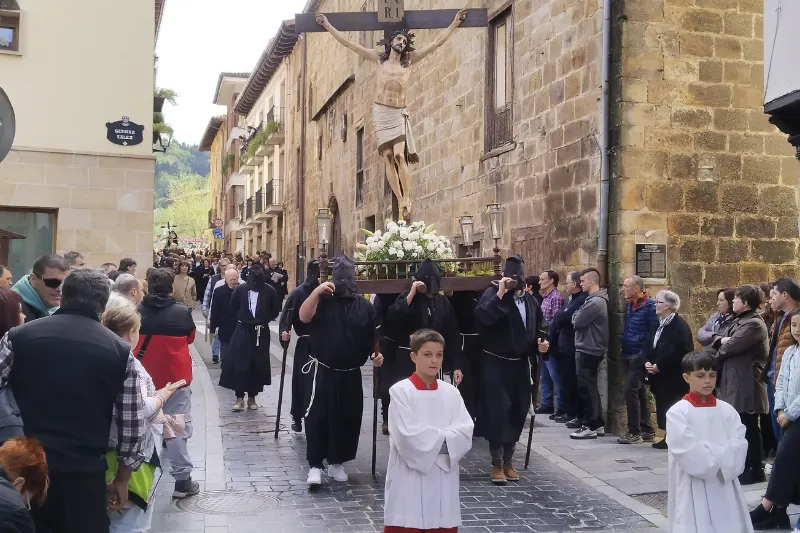
Things start shifting before the official week begins. Viernes de Dolores, the Friday of Sorrows, is low-key compared to what follows. Parish gatherings, traditional chants, local brotherhoods preparing religious imagery behind the scenes. Not a spectacle, more like the city collectively getting into a different headspace before the main events arrive.
Palm Sunday is when the streets actually wake up. Artisans show up from surrounding villages carrying palm fronds and local plants, weaving them into crosses and figures on the spot. These get blessed at mass and then hung on doors around the city, supposedly keeping evil out for the rest of the year. It sounds minor but watching the weaving happen and seeing finished pieces carried home by families gives the week a grounded feeling that the bigger processions don’t always have.
Holy Monday: The Lord of the Earthquakes
Nothing else during the week comes close to Monday. The entire day centers on the Señor de los Temblores, and the story behind the devotion is worth knowing before showing up.
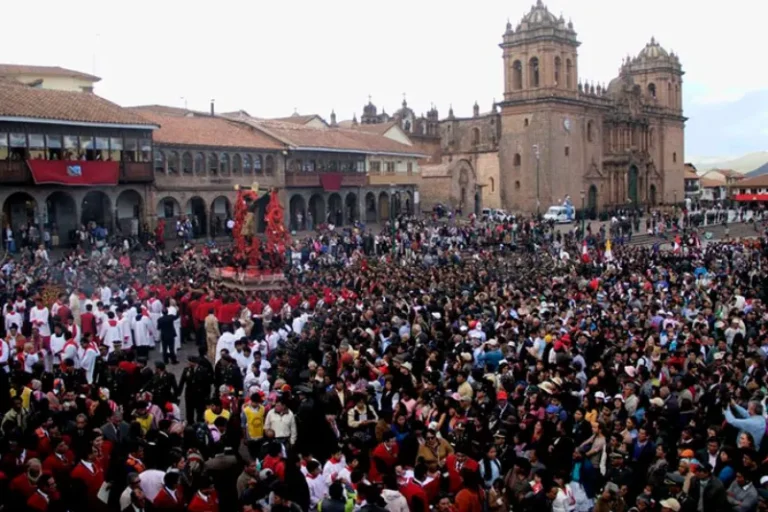
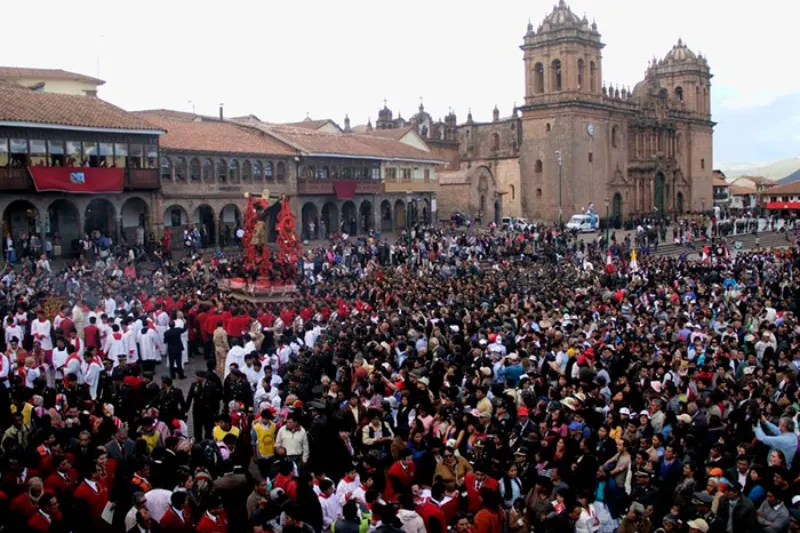
1650, Cusco. A massive earthquake tears through the city and brings large parts of it down. According to what locals have passed down ever since, the tremors stopped only when the dark-skinned crucifix was carried out of the cathedral and into the open streets. That moment became the foundation of the statue’s identity as the city’s sworn protector, and the reverence around it has only compounded over the following centuries. The statue comes out of the Cathedral in the mid-afternoon most years, and the crowd’s reaction when it appears isn’t performative. People who have watched this their whole lives respond the same way every time.
The crimson petals raining down through the procession aren’t just visually striking. The ñucchu flower represents Christ’s blood in Catholic terms, but that same flower was a sacred offering to Inca gods long before any Catholic framework arrived. Both meanings run simultaneously and locals don’t see a contradiction in that.
Practical tips for Holy Monday:
- Secure a prime vantage point: Cafe balconies on the second floor around the Plaza de Armas are the best option. Ground level on the plaza steps works but needs two to three hours of waiting to hold a decent spot.
- Show proper reverence: Voice down, no flash photography at devotees, stand still when the statue passes and the blessing happens. Following what the people around are doing covers everything else.
Holy Thursday and Good Friday: Churches, Crosses, and Cuisine
Thursday evening slows down after Monday’s weight. The tradition is walking to seven churches across the historic center, stopping at places like La Compañía de Jesús, San Blas, and La Merced to pray and reflect on the Last Supper. Families do it together, at their own pace. It’s social in a relaxed way and gives a different experience of the city than standing in a crowd watching a procession.
Good Friday splits into two separate things. Morning is the Via Crucis, a genuine uphill climb to the Cristo Blanco statue or Sacsayhuamán fortress. Thousands of locals do it and the effort is real, steep terrain at altitude with no shortcuts. Faith and physical endurance working together in the same act.
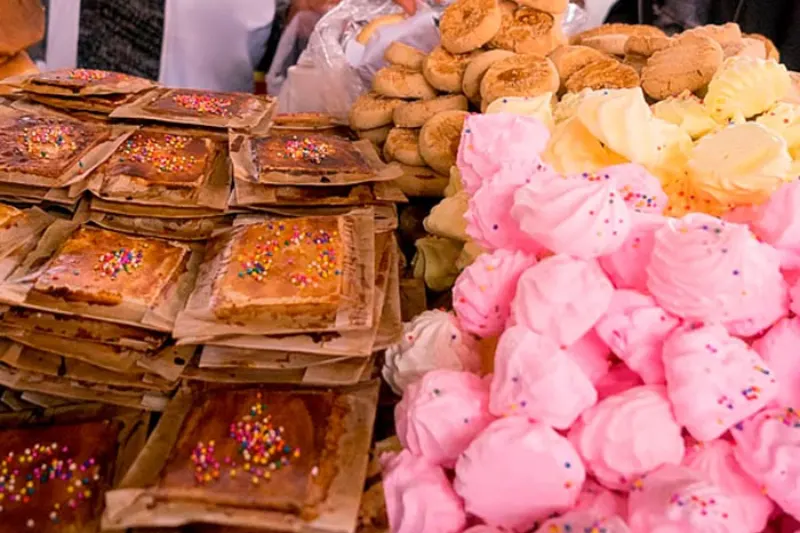
The midday meal is its own category entirely. Catholic abstention from red meat in Cusco produces twelve dishes rather than a simple fish plate, each one representing an apostle and built almost entirely from local agriculture:
- Chupe de viernes: Dense Andean vegetable soup, different from anything sold to tourists the rest of the year.
- Native potato casseroles: Multiple potato varieties cooked in ways specific to highland kitchens.
- Local trout: From Andean lakes and rivers, prepared simply.
- Pumpkin stews: Slow cooked, filling, very much a cold-weather dish.
- Mazamorra and apple empanadas: Sweet dishes that finish the meal.
A Tapestry of Two Worlds
Spain’s version of Holy Week is built on silence. Hooded penitents, mournful processions, grief as the central register. Cusco shares the same Catholic calendar and almost nothing else. Quechua hymns replace Latin solemnity. Local flowers carry pre-Catholic symbolism. The feast tables are stocked with highland produce that connects directly to agricultural cycles the church calendar absorbed rather than replaced. Two traditions developed in completely different conditions and the gap between them is visible in every detail.
Planning Your Trip: Practical Tips for April in the Andes
- Prepare for shifting climates: April sits at the edge between rainy and dry season. Daytime is usually clear and pleasant. After dark the temperature drops faster and further than most visitors plan for.
- Pack smart: Layers handle the range better than any single item. Waterproof jacket, shoes that handle wet uneven cobblestones without slipping, strong sunscreen because the altitude makes the sun hit harder than it looks, and something genuinely warm for evenings.
- Navigate the masses: Early mornings at archaeological sites while locals are at mass. Afternoons in neighborhoods like San Cristóbal above the plaza, where the crowd density drops and the streets feel closer to everyday life.
The details are what make Holy Week in Cusco register as something other than a travel experience. The specific history of the Lord of the Earthquakes, what the ñucchu flower meant before the Spanish arrived, why the Good Friday feast has exactly twelve dishes. None of that is decoration. It all points toward something older than the week’s Catholic structure. Coming in with some understanding of that context and genuine respect for how locals live it turns observation into something that stays.