
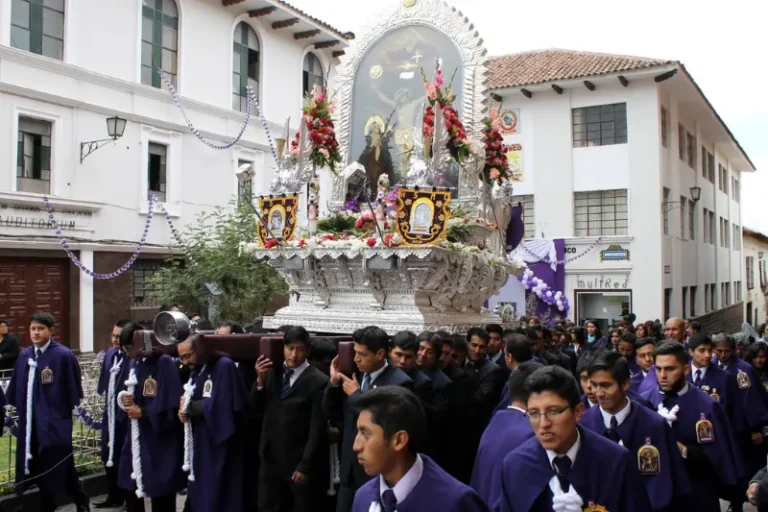
October changes the character of Cusco’s streets in a specific and visible way. Palo santo smoke thickens the air, deep violet appears everywhere on people who rarely dress that color the rest of the year, and the historic center fills with a kind of collective focus that doesn’t show up during ordinary weeks.
Locals call it Mes Morado, the purple month, and the Lord of Miracles procession drives all of it. What started as a coastal Lima devotion in the 17th century found its way into the high Andes and took on a shape here that reflects the specific religious character of Cusco rather than just copying the original.
The Mural That Wouldn’t Fall: How a Slave’s Painting Sparked a Centuries-Old Devotion
The origin sits in 17th century Lima. An unnamed Angolan slave painted Christ on an adobe wall in Pachacamilla, a modest district where enslaved Africans gathered. The painting wasn’t public art in any formal sense. It was a personal sanctuary for a community with very little else to hold onto.
The 1655 earthquake leveled most of Lima. That particular wall didn’t fall. Devotees read the survival as something divine and the local shrine became a serious center of faith almost immediately after the rubble cleared. Decades later a woman named Mother Antonia Lucia arrived to care for the image and started wearing a simple deep violet tunic.
That choice permanently established purple as the color of the devotion. Her presence also deepened the religious syncretism already developing around the image, Catholic practice and indigenous tradition folding into each other through the ritual.
The devotion eventually moved inland and upward into the Andes. When it reached Cusco it stopped being purely a Lima tradition and started carrying local weight.
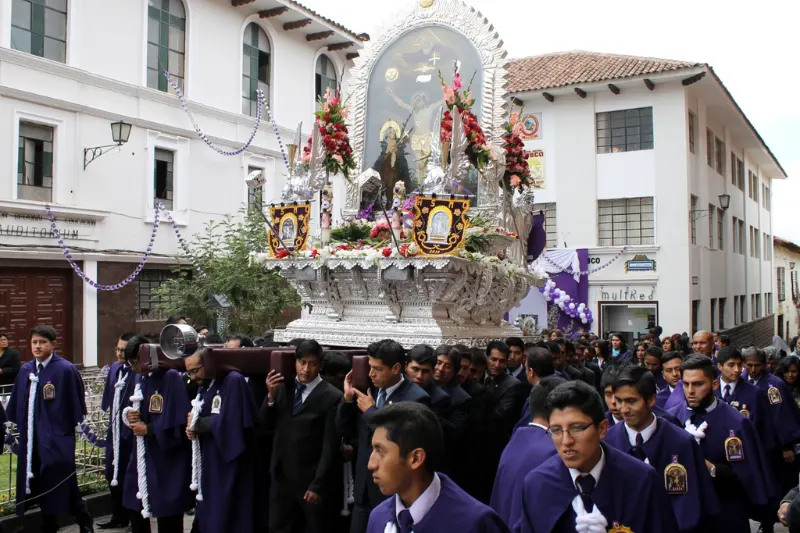
Cusco’s Unique Twist: Señor de los Temblores vs. Señor de los Milagros
October in Cusco produces a reasonable amount of confusion for visitors because two significant religious figures both connect to earthquakes and both carry deep local reverence. They’re not the same thing and the differences matter.
The Señor de los Temblores is Cusco’s native protector, a soot-darkened statue carried through the streets during Holy Week in April. That figure is rooted specifically in Andean earth reverence layered onto Catholic tradition. The Lord of Miracles is a canvas reproduction of Lima’s mural, celebrated in October, and its presence in Cusco represents the devotion traveling from the coast into the highlands rather than originating here.
San Francisco Church serves as the local hub for the October festivities. The procession route works outward from those doors through streets that weren’t designed for the volume of people who show up. Narrow colonial alleys, centuries-old stone underfoot, the mountain breeze carrying incense smoke ahead of the float. Coordination among the people carrying the platform through those turns requires a level of collective discipline that becomes obvious watching it happen.
Heavy Shoulders and Sweet Smoke: The Roles of Cargadores and Sahumadoras
The sahumadoras arrive first. These women carry burning incense ahead of the float, purifying the path and moving the crowd’s prayers upward through the smoke. They function as spiritual preparation for what follows rather than as ceremonial decoration.
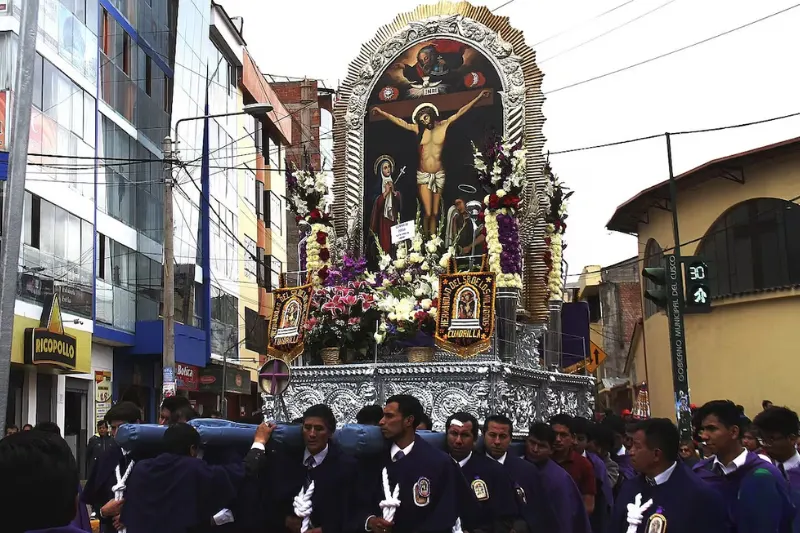
Behind the smoke, dozens of men carry the anda, a massive wooden platform holding the image. The weight compares to a small car distributed across human shoulders, moved through narrow streets in rhythmic swaying unison. Watching the cargadores negotiate a tight corner while maintaining that collective rhythm under that load is something that stays with people.
Getting under those beams isn’t casual participation. The hermandad de cargadores recruitment runs through four specific stages:
- Petition: Aspiring members submit formal requests, often fulfilling promises made by family members across generations.
- Observation: Candidates spend a full year assisting with parade logistics before carrying anything.
- Training: Men build the specific endurance needed to handle sustained physical effort in thin mountain air.
- Vows: Members commit to lifelong spiritual and community service, not just annual participation.
The physical exhaustion involved is understood by participants as the point rather than as a cost.
A Taste of Faith: Where to Find the Best Turrón de Doña Pepa in Cusco
Anise and honey hit the air after the procession passes and that smell belongs specifically to Turrón de Doña Pepa. Dense layered pastry built from anise-flavored cookies, dark fruit syrup poured over them, bright candies scattered across the top. The recipe traces back to Josefa Marmanillo, an 18th century Afro-Peruvian woman who credited the painted Christ with curing her paralysis and invented the sweet as a personal offering of gratitude. That origin gives the dessert a different weight than most festival food carries.
Reliable places to find it in Cusco during October:
- San Pedro Market: Traditional stalls selling thick freshly made blocks throughout the festival period.
- Local Bakeries: Shops near Plaza San Francisco run premium versions that differ from the market stalls in texture and syrup quality.
- Procession Street Carts: Fastest option for grabbing a slice while moving through the crowd.
Navigating the Crowds: Your Practical Guide to the Cusco Procession Schedule
The main processions center on October 18th and 28th. Traffic through the historic center stops during both and the streets fill with violet well before the float appears. Arriving early enough to secure a position matters more than most people account for when planning the day.
Elevated spots change the experience significantly. Second-floor balconies around Plaza de Armas, the Cathedral steps, and Calle Mantas all offer clear sightlines over the crowd without getting absorbed into it. From those positions the incense bearers are visible before the float arrives and the full scale of the procession reads better than from street level.
Dress modestly with covered shoulders, keep quiet when the float passes, and don’t cross directly in front of the approaching bearers. Following what the people around are doing covers most of the unwritten expectations.
Beyond the Purple Robes: Embracing the Spirit of Cusco’s Most Vibrant Tradition
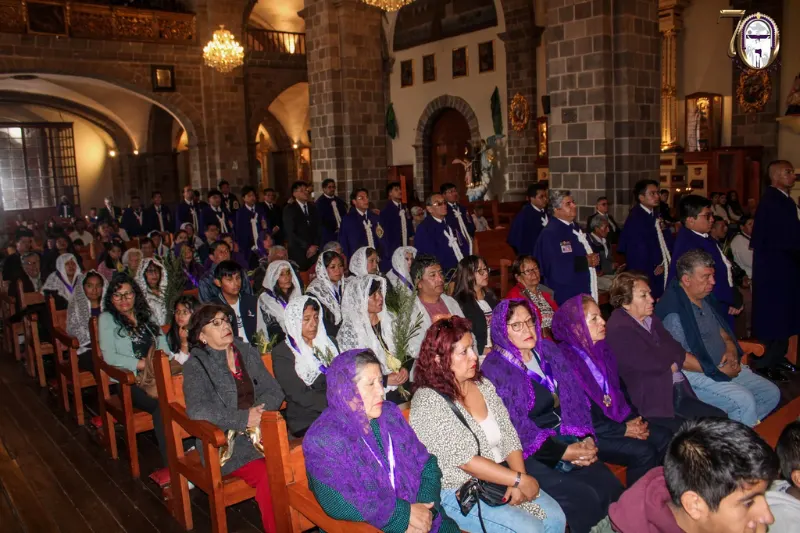
The Lord of Miracles in Cusco isn’t primarily a spectacle for outside audiences. The cargadores under that weight, the sahumadoras moving through the smoke, the people lining the streets in violet who’ve been doing this every October their whole lives. All of that is operating on its own logic regardless of how many visitors show up to watch.
A few simple ways to participate rather than just observe:
- Wear purple to show solidarity with local devotees rather than standing visibly apart from the crowd.
- Buy Turrón from street vendors and eat it while the procession moves past.
- Stand quietly on the sidewalk as the float approaches and let the moment move at its own pace.
The smell of palo santo in cold Andean air, violet filling streets that are normally just historic and quiet, the sound of the cargadores moving in rhythm under something almost too heavy to carry. It accumulates into something that doesn’t require explanation to land.